“Thy word have I hid in mine heart, that I might not sin against thee.” (Psalm 119:11, KJV)
I want more of God’s Word in my heart. I want it to come to mind when I wake up worried in the middle of the night, when I’m praying and don’t know what else to say, and when I’m frustrated and about to speak before I’ve thought it through. I’m starting with Psalm 91.
Why hide God’s Word in our hearts?
The Bible is God’s Word. Jesus prayed, “thy word is truth” (John 17:17), and said that His words “are spirit, and they are life” (John 6:63). Proverbs tells us to write God’s commands “upon the table of thine heart” (Proverbs 7:3) and says, “Let thine heart retain my words: keep my commandments, and live” (Proverbs 4:4). I want His words to stay with me long enough to shape the choices I make.
Proverbs 27:19 gives us the picture of a face reflected in water. Jesus shows us how much our words reveal about our hearts when He says, “out of the abundance of the heart the mouth speaketh” (Matthew 12:34). In Luke 6:45, He tells us that a person brings forth what’s stored in the heart. Proverbs 4:23 tells us to guard it diligently, “for out of it are the issues of life.” What I store up in my heart comes out in the words I speak and in what I do. I think of the simple instruction in Psalm 37:3 to “Trust in the LORD, and do good.”
Philippians 4:8 tells us to think on what is true, honest, just, pure, lovely, and of good report, and on what is virtuous and worthy of praise. There are so many more places in Scripture that call us to give God our attention. Memorizing a passage gives me words I can return to throughout the day, think on slowly, and pray back to Him.
If you’ve ever wanted to memorize a whole chapter of the Bible, start the same way you would with one verse. Pick a translation you’re comfortable reading aloud and stay with it while you learn the passage. I’m using the King James Version for Psalm 91.
Read it, cover it, and say it
- Read the whole passage first. Read slowly enough to follow the thought. Notice who’s speaking, what they’re saying, and where the thought changes.
- Start with one phrase. For a single verse, pause where you’d naturally take a breath. For a chapter, divide it into short sections that belong together, then learn one phrase at a time. Say the reference aloud as you practice so it comes to mind with the words.
- Cover the words and say them aloud. When you get stuck, glance at the words, cover them again, and try the whole phrase. Add the next phrase, then say both together.
- Come back to it later. Try to say it again that evening and the next day before you look. When you add a new section, practice the last line of the previous section right into the first line of the new one. Once you’ve learned the passage, come back to it in a few days and again the following week.
I’m starting with Psalm 91
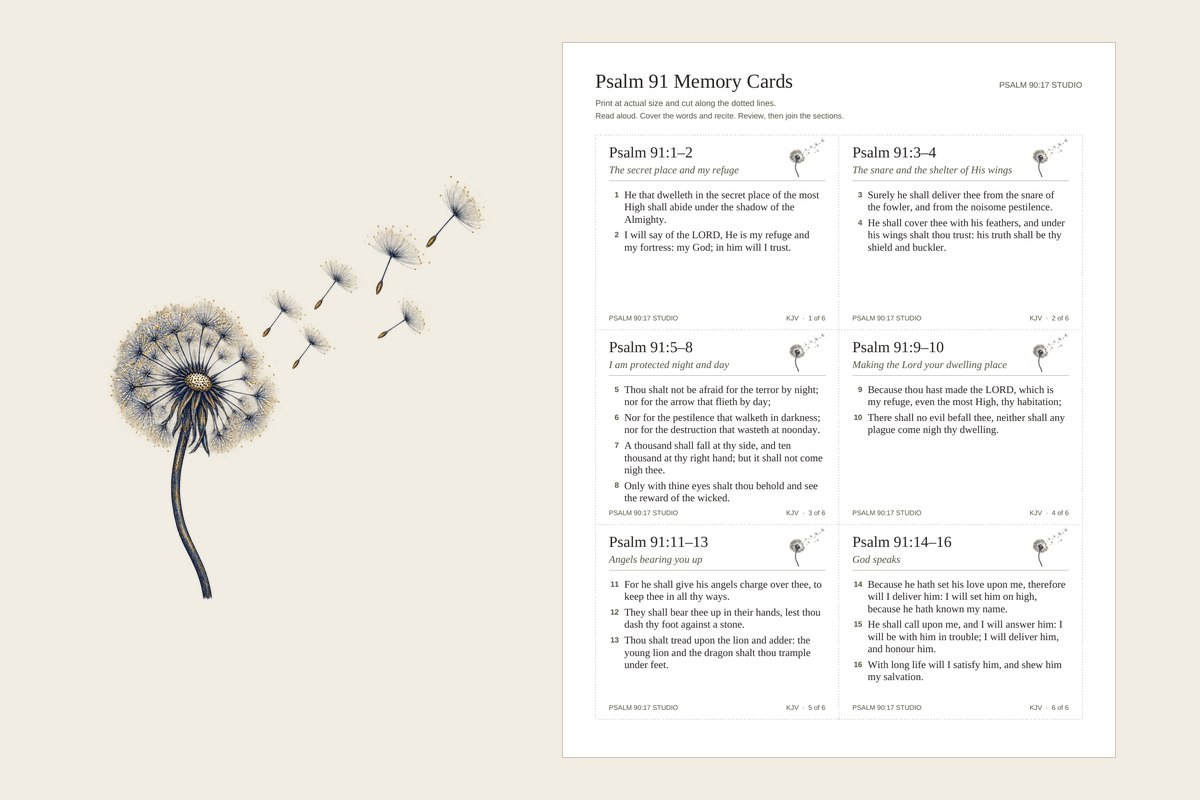
I divided Psalm 91 into six cards. Each one has a short cue to help you remember what comes next. The first card takes me from the secret place to the words “my refuge and my fortress.” By the last card, the voice changes and God says, “I will be with him in trouble.” That’s a line I want to be able to pray over my own heart.
If you’d like to learn Psalm 91 with me, download the free Psalm 91 Memory Cards. The six cards fit on one letter-size sheet and include all 16 verses in the KJV. Print them at actual size, cut along the dotted lines, and keep the card you’re working on where you’ll see it again.
I’m going to begin with verses 1 and 2. I’ll read them out loud, put the card down, and see what I remember. And when I get to “my God; in him will I trust,” I’m going to stop there for a moment and pray it.
More from the journal →